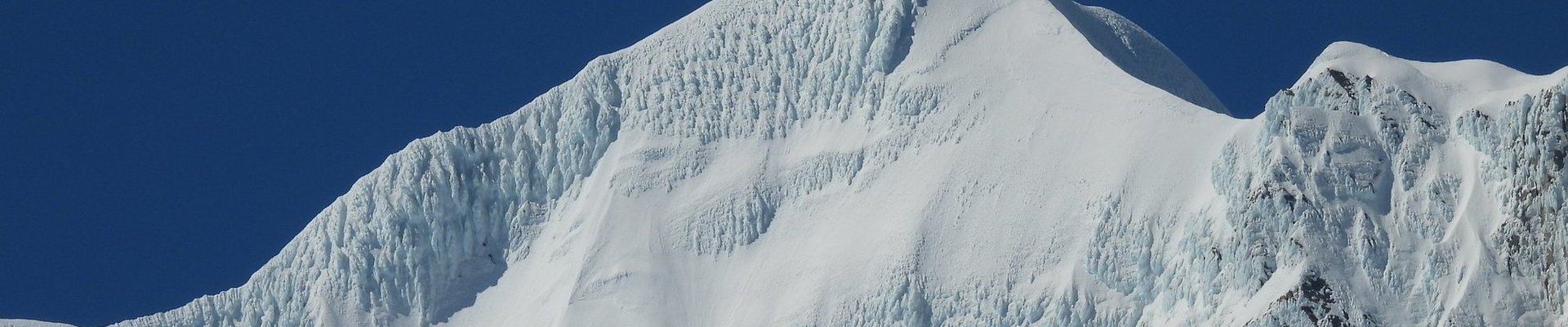
Te Wahipounamu comprises a range of protected areas in South West New Zealand. Here, tectonic and glacial processes have shaped a mountain landscape dotted with fjords, glacial lakes, glaciers and moraines. All parks and reserves are free to enter and visitor access is well-managed by the Department of Conservation.
Find below my highlights while traversing the area from North to South. I exited via the Haast Pass, so I skipped Fiordland, trying to avoid the crowds and costs of Queenstown and the cruises, as I soon would be on a ship for 10 days on end. In general, I found the South West the most touristy and expensive region of NZL.
Okarito Lagoon
Before I left on my Big Trip, I saw a documentary on TV highlighting Okarito Lagoon and its White Herons. This is a wetland area in the far north of Te Wahipounamu. I was completely fascinated by it and put this lagoon at the top of my to-do list for the area. The waters are home to the New Zealand white heron. This is a very elegant bird that grows long plumes on its back during the breeding season. Obviously, the documentary was shot at exactly the right time and with all access necessary. As a casual visitor, you have to join a guided tour to enter their Waitangiroto breeding colony.
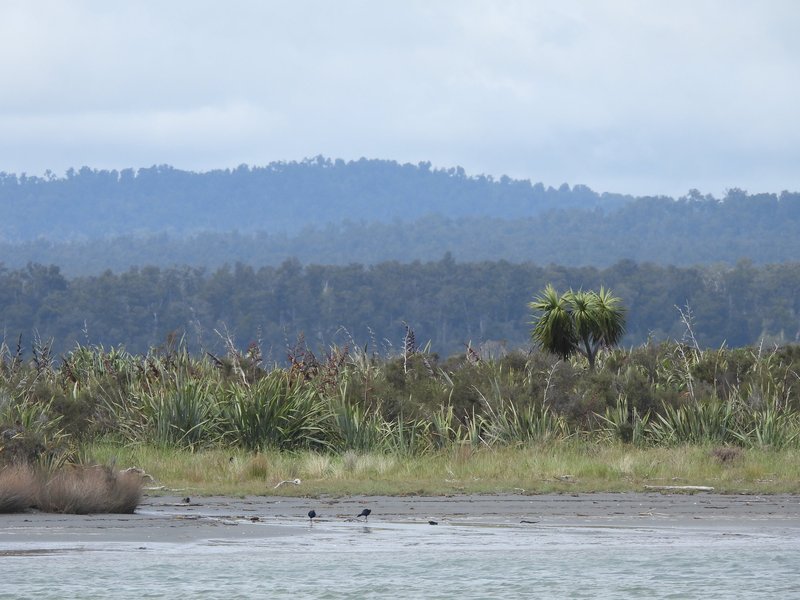
I went by myself to Okarito Lagoon, which was a big disappointment. First, there is a boardwalk trail that leads across a heavily reeded wetland to nothing. On the other side of the village, which has its roots in the Gold Rush period, you can stare at where the lagoon starts, but without any bird life present except for the common oystercatcher.
Fox Glacier and Mount Cook Heli Tour
I decided only two days before I arrived to do a helicopter tour in this area. Views of these glaciers are so restricted nowadays that it can be summarized as “You can't walk very far and don't see much”. There aren’t tons of other things to do around Franz Josef Glacier and Fox Glacier, so I searched for a helicopter tour despite the nagging feeling that all those helicopters flying around here can’t be good for the fast-retracting glaciers either.
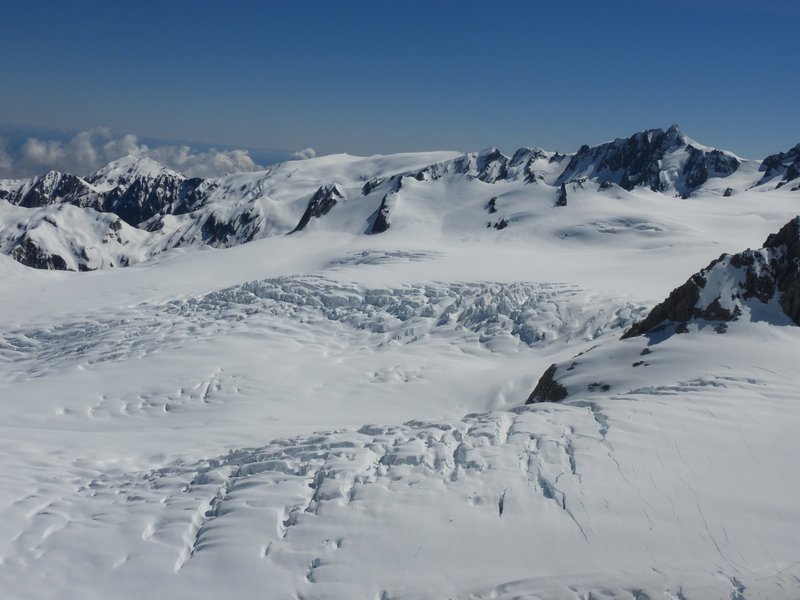
My 35-minute tour was with 4 other people (who had to sit in the back) and fortunately, I was assigned the seat next to the pilot. As with the two other times I was in a helicopter, it felt vulnerable at first (much more so than being on a small plane does). But I started enjoying it quickly as we flew to all the good parts: Mount Cook, New Zealand’s highest mountain, and Mount Tasman, close to it, the second highest. We landed at a flat, snow-covered area at the top of Fox Glacier. Here we could walk around a bit. What you can clearly see from the top is that several subglaciers feed into the big one known as Fox Glacier.
On the way back, we followed the main flow of the glacier into the valley. The snow and ice-covered part stops quickly; what remains is only rock debris. Fox Glacier has been retreating since 2009 and has lost some 900 metres, although it must be said that it advanced at a rate of about a metre per week between 1985 and 2009 – so maybe it is a pattern of ebb and flow.
Lake Matheson
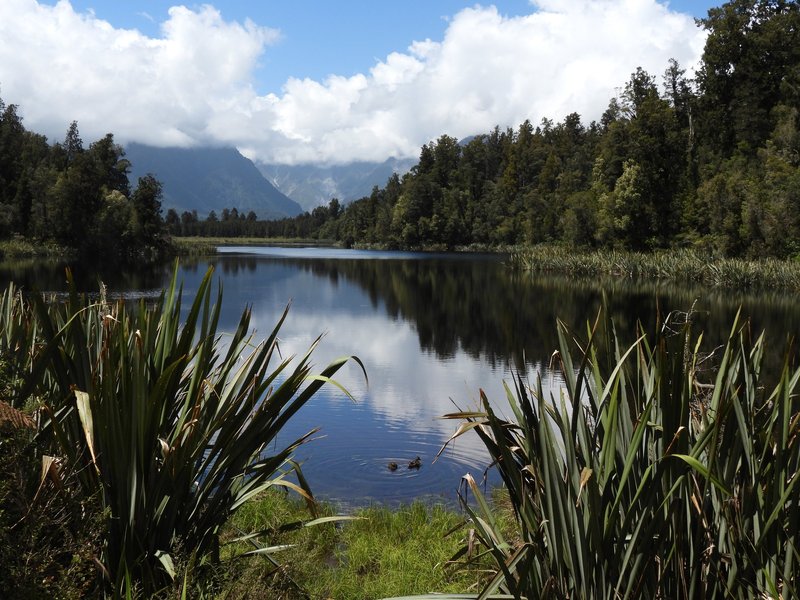
Near Fox Glacier town lies Lake Matheson, another popular attraction. It is a large glacial lake where, on clear days, a reflection of Mount Cook can be viewed. There’s a loop trail around it, taking about 1.5 hours. It’s a very easy walk and it seems doable for everyone, so it’s popular with families. Mount Cook was hiding behind clouds when I visited, so I did not see the full reflection.
Franz Josef Glacier
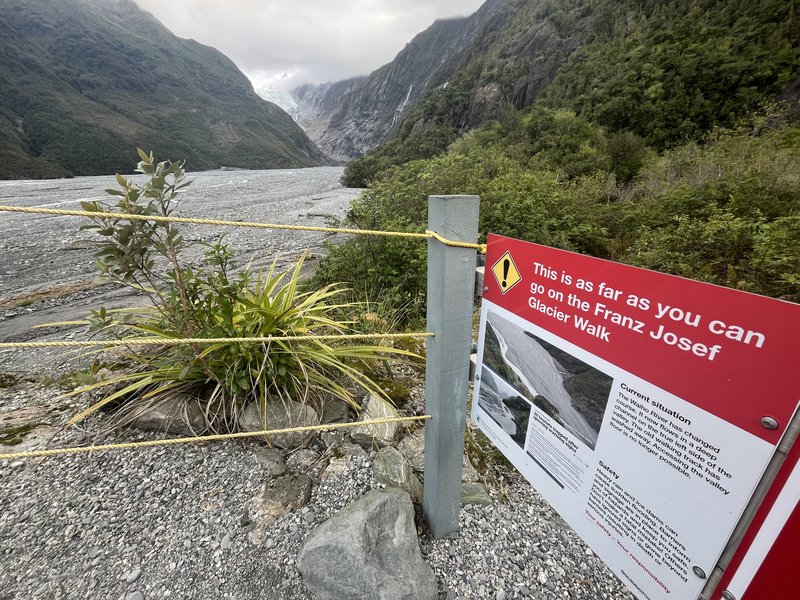
In the early evening, I visited the Franz Josef Glacier by car and on foot. The trail nowadays goes only as far as 30 minutes; after the river changed its flow in 2020, the original path became inaccessible. Still, it is the most popular walk in the area and a huge parking lot caters to all these tourists. You can see the ice mass in the distance, but it is hardly a worthwhile sight.
A fine detour from the parking lot is to take the Peter’s Pool trail – just a side trail of about 20 minutes, but it leads to a picture-perfect kettle lake. It mirrors the Franz Josef Glacier, and I found it more scenic than the bigger one at Lake Matheson. If you sit by the lake for a while, you’ll notice a variety of birds. I especially liked the Tui (a colourful native bird of NZL, with a white tuft of feathers on its neck), which I had seen before in the forests, but here they are easier to photograph.
Monro Beach
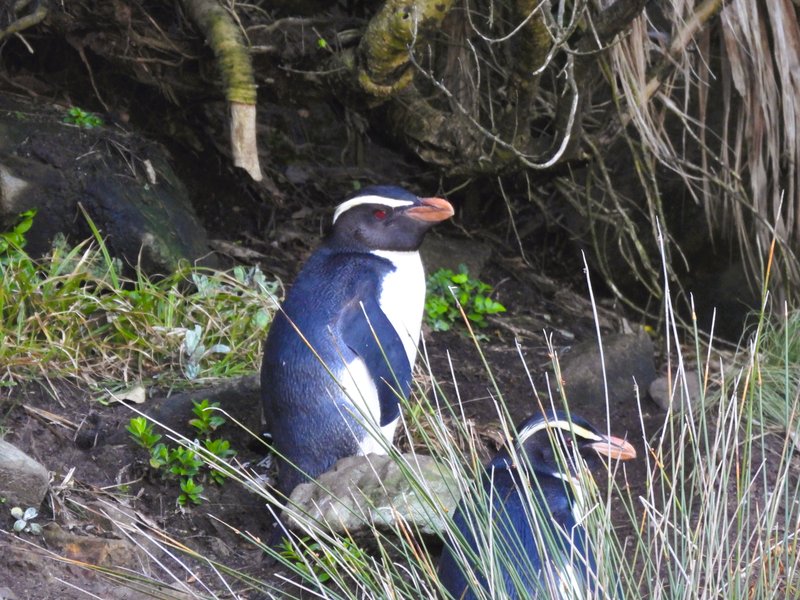
The next day, I got up early to give it a shot to see Fiordland penguins, a species endemic to New Zealand. The Monro Beach Walk (1.5 hours return, easy) provides access to the nesting grounds of approximately 30 pairs. The hike itself is a fine one as well, as it crosses a dense, jungly coastal rainforest. There’s a fun swingbridge to cross and lots of boardwalk to keep your feet dry. Once at the beach, I knew I had to walk to the right, but I did not see any penguins near the rocks or in the water. I worried that they had already left for the day (they usually go out fishing in the early morning and return late afternoon), but when I turned around, my eye fell on something very white in the bushes high up against the cliff. Two penguins standing guard!
Guide to see the penguins at this spot:
- They are only there from July – early December.
- You must arrive within 2 hours of low tide; otherwise, “their” part of the beach becomes inaccessible.
- They hang out at the far northern side of the beach (to the right coming from the forest path).
There’s also an exclusive Wilderness Lodge next door if you want to improve your chances of sightings.
Haast Pass
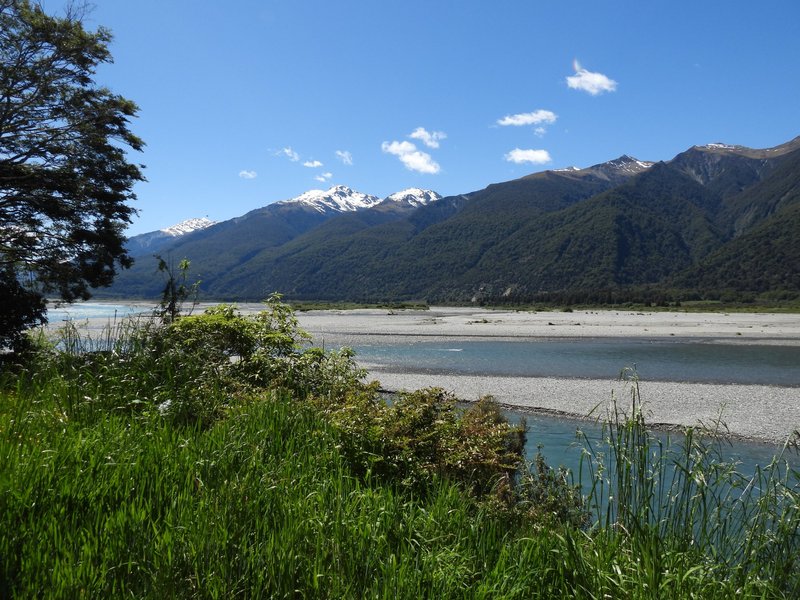
I left the core zone via the Haast Pass. This road through Mount Aspiring National Park offers sublime views of its steep mountain ridges. Despite the ‘Pass’ in its name, there isn’t much difference in altitude to overcome along the way. It’s a very popular route and many of the parking lots to the short walks accessible from here were chock-full. This was also true for the 1h walk to Blue Pools, which I had singled out beforehand. So I just drove on to my final destination Wanaka, already outside of the core zone but with a great mountain panorama behind its lake.
Comments
No comments yet.