FRIM has been almost overreviewed since its inscription last summer. Its proximity to the travel hub of Kuala Lumpur is surely due to that. I also take any excuse to return to Malaysia, so I made a stop-over there for two days in between my trips to Vietnam and Sri Lanka.
ICOMOS found FRIM a bit of a theme park with half a million visitors a year, mountain biking (God forbid!) and judged that “the management of the nominated property is oriented towards recreational activities rather than conserving and protecting the biodiversity of the FRIM FPS.” Most of our reviewers found little of note either, although they generally did not get beyond the Botanic Gardens or the Skywalk, which (although within the core zone) hardly contribute anything to the site’s OUV.
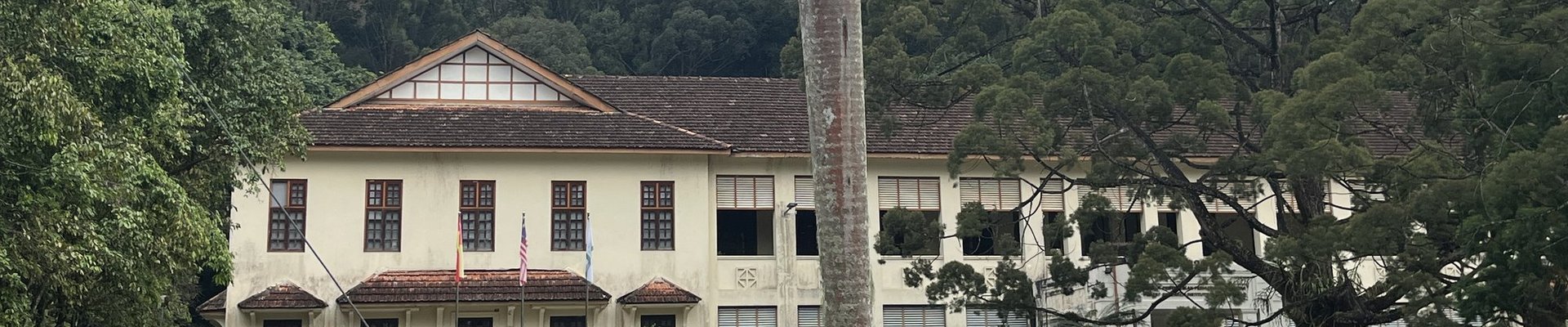
If you’d like to give it a fair chance, you have to book a “Nature Trek” with the park. I did so about 3 weeks beforehand. It is a private tour within the man-made forest, costing 150 MR (30 EUR) for a group of up to 10 people. I was assigned a 8.30 am time-slot, and arrived by Grab at the gate of the Main Entrance around 8. The inscribed area includes the full gated compound, known as the Campus, where many research facilities are located. It still even includes a school for the children of the workers and those of the wider neighborhood. In the 1920s, the Campus was set up similar to a company town – with its own housing quarters, clinic, places of worship and recreational facilities, since it was situated in an isolated area.
My guide was Mr. Ong, who had worked at FRIM for 50 years. The tour normally includes a visit to the exhibition at the museum, housed in one of the original colonial buildings, but it is under reconstruction at the moment. So I was promised an extra-long walk, which took over 2 hours (we took the Keruing Trail). From what I read beforehand, leeches are common here and you can even buy leech socks at the souvenir shop of the visitor center. But it had been dry for a while, and even Mr. Ong was not worried (although we both wore long pants and long-sleeved shirts).
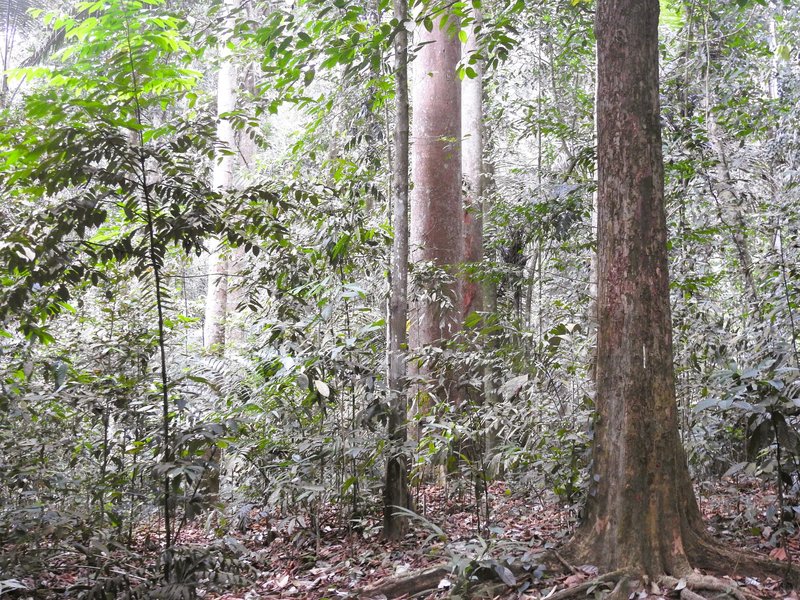
There are a couple of aspects in which a man-made forest differs from a natural forest. First of all, many of the trees were planted here neatly, in rows, although I did not find it that visible (the photo above shows it a bit). Secondly, the tree species weren’t all sourced from the region; there are species from South America as well for example. They just went with what went well with the climate and the soil. In the almost 100 years since the forest was established, the scientists have planted about 1,000 species. But another 1,000 species have, over time, been blown in by the wind or brought in by animals.
A natural wonder that is helped by human intervention is the formidable display of Crown shyness (the social distancing of tree canopies). This phenomenon is globally spread, but only a few tree species excel at it. The fact that at FRIM trees of the same species and of the same age exist as neighbours without mingling of other species helps the Crown shyness to show off particularly well. The guide said that the Crown shyness is the main reason people want to visit FRIM. A special viewing platform has been built to see the best example.
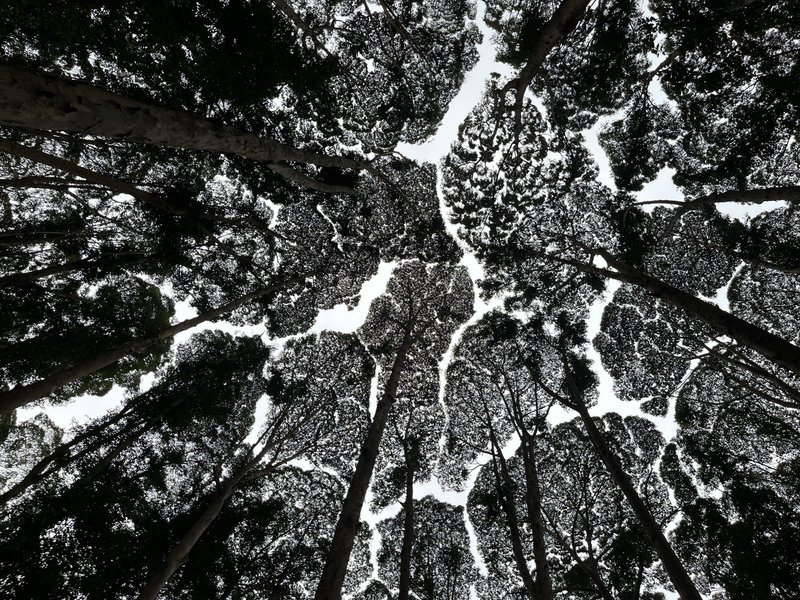
We stopped at a dozen other plants and fungi as well. There are hardly any flowers or berries here. We heard some birds and saw squirrels, but the larger animals stay safely much deeper into the forest. With 233 bird species and 62 mammal species, restoring biodiversity has been a great success, something I find has been underexposed in the AB evaluation (which was done by ICOMOS only, since it is a cultural site). This green lung, so close to Kuala Lumpur City, has become a popular place with the animals, as they don’t care how the forest was “made”. During COVID, the scientists even spotted a leopard on one of their camera traps on the trails.