
This is the second phase of my eight-day journey to Pyay, ancient Sri Ksetra, and Beikthano, undertaken after an invitation from an archaeologist I met during an ICOMOS field trip in Viet Nam. After three days exploring the vast plains and shimmering waters of Sri Ksetra, our group set out for Beikthano. The road stretched for nearly four hours across rural Myanmar, dotted with military checkpoints. While checkpoints are common from Yangon to Pyay, those beyond Pyay seemed more active and watchful, a stark reminder of the country’s fragile political climate. The landscape shifted as we drove. Sri Ksetra had been vibrant, crisscrossed by canals, reservoirs, and green fields, but the approach to Beikthano revealed endless dry rice plains, bleached under the sun. As we entered the archaeological zone, our Myanmar SIM cards lost signal entirely, a precaution for military security, our guide explained.
Our exploration began at the Beikthano Ancient Museum. Its displays echoed what I had seen in Sri Ksetra and at Yangon’s National Museum: terracotta objects, stone urns, beads, and fragments of architecture. With fewer excavations here, the collection felt modest, yet it provided an essential glimpse into the earliest stages of Pyu civilization. From the museum, we visited Beikthano Village, known for its pottery. The villagers produce exquisite earthenware, often adorned with motifs reminiscent of ancient Pyu designs. It was a rare joy to witness a living craft that so closely echoes a culture more than two thousand years old. The most photogenic stop was the group of White Pagodas of Vishnu, a cluster of later period stupas beside a still reservoir. Though not originally Pyu, their elegant forms and pristine white domes reflected against the stark landscape, offering a moment of serene beauty and a striking symbol of Beikthano. Interestingly, Beikthano means Vishnu, highlighting the city’s link to Hinduism even as the Pyu practiced Buddhism. Inscriptions and ancient texts show that the Pyu adopted Hindu deities, symbols, and cosmology alongside their Buddhist practices. This religious syncretism demonstrates their openness to foreign ideas, blending them into a distinctive local interpretation visible in architecture, inscriptions, and ritual objects.
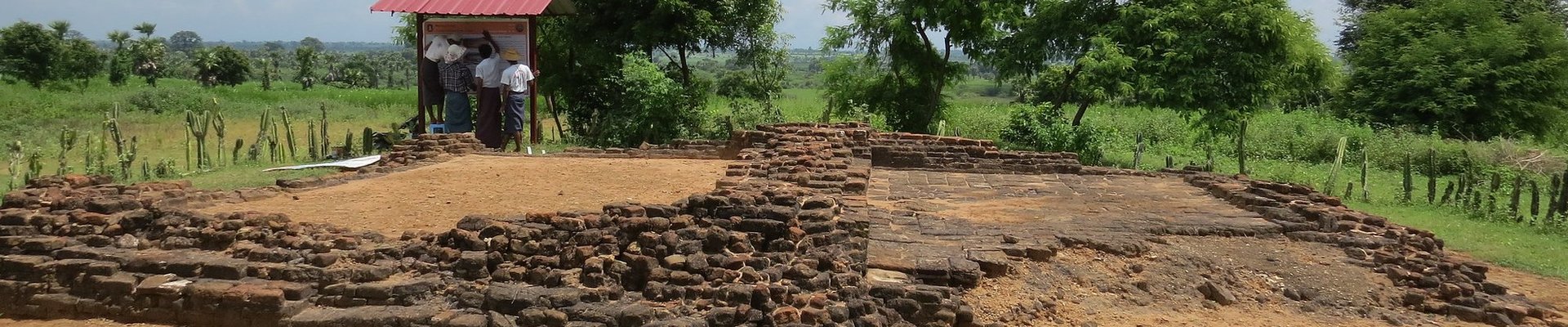
We then visited the Beikthano Consort Cemetery, where funerary urns resemble the Terrace of Urns in Sri Ksetra. Local legend tells that Beikthano was founded by a princess. When the kings of Sri Ksetra invaded, they captured the princesses and brought them to Sri Ksetra, a story that connects to a similarly named historical site there, associated with royal consorts. The cemetery thus intertwines archaeology with myth, linking the two Pyu cities across history and legend. Across the site, numerous temple ruins remain, mostly platforms hinting at vanished structures. For the untrained eye, they are abstract shapes, but patterns emerge, Amaravati style stupas and ornamentation, reflecting the shared artistic vocabulary of the period. The Monastery Ruins, particularly the meditation rooms, bore a striking resemblance to the Buddhist Vihara at Paharpur in Bangladesh, underscoring the reach of Indian monastic architecture across Southeast Asia. The City Gate echoes the Nagatunt Gate of Sri Ksetra, and even the palace, though reduced to a platform, hints at past grandeur. Perhaps Beikthano’s fragmentary state is due to its destruction by Sri Ksetra, a historical event that leaves it less monumental, yet no less culturally vital.
Pyu art and architecture more broadly, mark the beginnings of Buddhist urban civilization in Myanmar. As one of the earliest cultures in mainland Southeast Asia to embrace Buddhism, the Pyu blended Indian influences with local creativity to form a distinctive aesthetic. At Beikthano, city planning, early monastic complexes, funerary urns, and stupa foundations reveal a society that was both inventive and spiritually oriented. Though modest compared to Sri Ksetra, the site provides an exceptional window into early urban culture, monumental religious architecture, and enduring traditions centuries before Bagan’s golden age. What survives today is more than ruins; it is the foundation of Myanmar’s artistic heritage, a testament to a civilization of vision, resilience, and spiritual depth.
For a casual traveler, Beikthano may seem modest. There are no dramatic ramparts or three iconic pagodas, yet its significance is profound. As the earliest and most archetypal Pyu urban center, dating to the first century BCE, it offers crucial evidence of urban planning, Buddhist culture, and state formation. In many ways, Beikthano is where the Pyu story begins. By late afternoon, we drove forty-five minutes to Taungdwingyi, the nearest town with tourist facilities. Beikthano itself remains largely untouched; an archaeological world preserved in silence, isolation, and immense historical weight.The next morning, I separated from the group and began the journey back to Yangon, passing through the earthquake damaged highway near Naypyidaw. Afterward, I boarded a flight home via Yangon, Bangkok, and Doha. As the plane rose into the deep night sky, the golden glow of Shwedagon Pagoda shimmered below me, a final beacon of light for this journey. My thoughts lingered on the Pyu, their silent ruins, enduring myths, and the remarkable civilization that had shaped Myanmar’s earliest urban and spiritual heritage. Yet I could not ignore the shadow of turmoil that has befallen this land, its people, and their treasured sites. In that golden radiance against the dark sky, I held a quiet hope that one day Myanmar will shine once more in peace and prosperity.
Comments
No comments yet.