
I was fortunate to join an ICOMOS international experts’ two weeks field trip to Cambodia and Thailand, exploring pre-Angkorian and Dvaravati art. This journey took me to Dvaravati Si Thep, Thailand’s upcoming UNESCO World Heritage nomination. Si Thep is one of the four contemporary ancient kingdoms of mainland Southeast Asia mentioned by Xuanzang in his travel records to India, Sri Ksetra (Myanmar’s Pyu), Chenla (Cambodia’s Sambor Prei Kuk), Champa (My Son in Vietnam), and Dvaravati. Given this context, it’s no surprise that Thailand is pushing for Si Thep’s inclusion on the World Heritage list to fill this historical gap.
The first thing I noticed at Si Thep was the city moat. The layout of the city is quite unique. Originally, it was built in a circular shape, which experts explained is typical of Dvaravati cities. Later, it expanded eastward in a rectangular form, giving the city a shape that resembles a mushroom or, as some experts joked, a giant lingam. We began our visit at a small museum that displayed artifacts and provided historical context. Afterward, sightseeing vehicles took us to the main temple area.
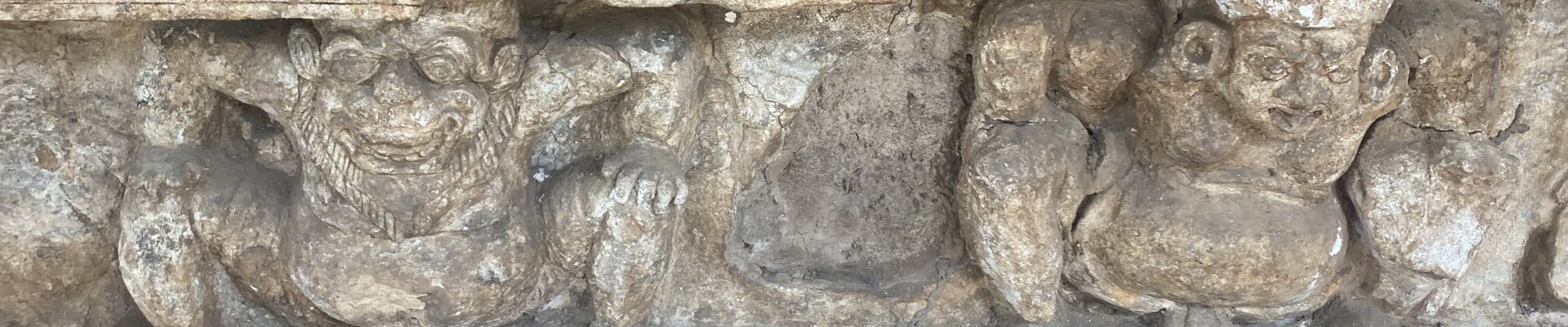
The main temple, Prang Si Thep, was built during the period when Si Thep became part of the Khmer Empire. Architecturally, it closely resembles temples I had seen in Cambodia, and I didn’t find it particularly interesting or unique. Not far from Prang Si Thep is Khao Klang Nai Temple, which I found more compelling. Built as a Dvaravati Mahayana Buddhist temple, its ruined stupa may appear like a pile of bricks at first glance, but the base features beautiful stucco decorations and motifs protected under a shed. The design of these elements, especially the dwarf statues, is distinct from those found elsewhere. The temple’s Dharmachakra, or Wheel of Dhamma, is also quite charming. According to the experts, while contemporary sites like Sambor Prei Kuk and My Son adhered closely to Southern Indian art styles, Si Thep developed a more liberal and unique interpretation, particularly in its Buddhist art.
Initially, I was almost disappointed with Si Thep. Aside from the beautiful stucco at Khao Klang Nai, there wasn’t much to see in the core historical zone. Most Dvaravati discoveries are artifacts rather than grand monuments like those at Sambor Prei Kuk or My Son. However, our visit to Khao Klang Nok Temple, located outside the city moat, completely changed my impression. This temple turned out to be the highlight of Si Thep, and my personal favorite, with the largest laterite stupa in the world. The square stupa features a beautifully designed platform shaped like small palaces, reflecting strong Indian influence and serving as a great example of early Indian art expansion. Although it lacks decorative stucco, its sheer size and design make it well worth visiting.
Another key site at Si Thep is the cave temple on Khao Thamorat Mountain. Unfortunately, we had to skip it due to logistical issues. However, from the top of Khao Klang Nok, we were shown the mountain and its significance in the city’s urban planning. Later, we saw Dvaravati Buddha heads from Khao Thamorat displayed at the National Museum in Bangkok and the Jim Thompson House. The story of Khao Thamorat’s looting by American cultural figure and spy Jim Thompson is well known among historians, reminiscent of the tale of Frenchman André Malraux and his involvement with Banteay Srei.
Like many sites in Cambodia, I doubt I would have appreciated Si Thep as much without the guidance of ICOMOS experts. On my own, I would have struggled to distinguish between Dvaravati, pre-Angkorian, Angkorian, and Indian styles, or to grasp the complex historical timelines of the region’s ancient kingdoms. Judging by the experts’ reactions, they were pleased to study Dvaravati culture at Si Thep and seemed to endorse its Outstanding Universal Value even before the World Heritage Committee’s final decision. For casual visitors, don’t let Prang Si Thep mislead you into thinking Si Thep is just another Khmer Angkorian site. Instead, focus on Khao Klang Nok and Khao Klang Nai to appreciate its unique Dvaravati art.
Comments
No comments yet.