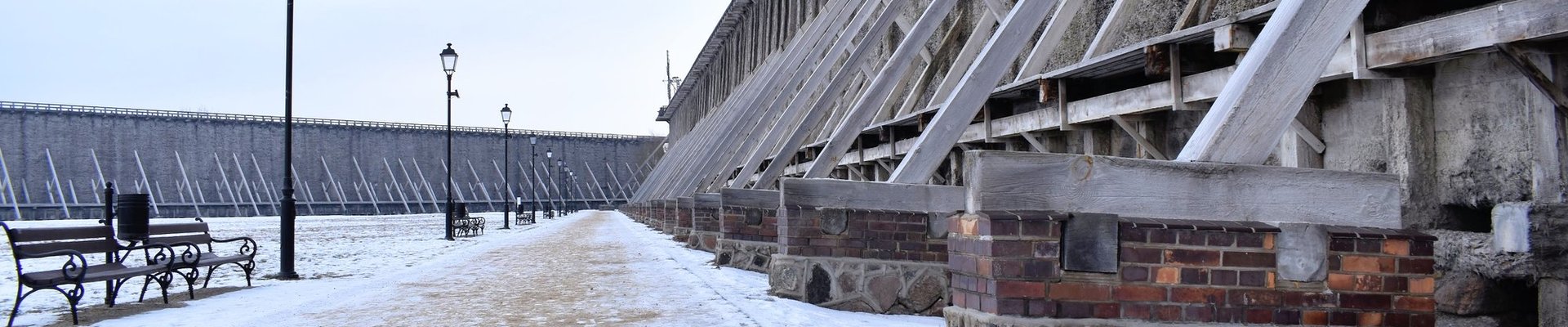
Admittedly, January is probably not the best time to visit the historic saltworks complex in Ciechocinek. The graduation towers are impressive, even when covered in snow and the atmosphere is truly calm and a little bit other-worldly with almost no one else around. But the main effect of graduation towers, to disperse salty air, is missing. When we visited on a snowy, cloudy Saturday in late January and walked past these huge wooden structures that are filled with blackthorn bundles, we could smell a faint hint of salt, but not much more.
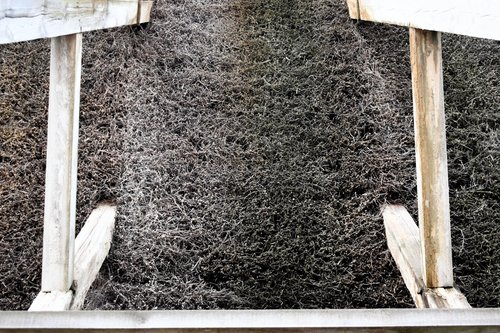
Growing up, my family would take weekend trips with my grandmother to a nearby spa resort that has similar albeit smaller graduation towers. My grandmother enjoyed the micro-climate around the graduation towers for its respiratory health benefits. But to me, as a child, the prospect of walking back and forth along a straight line of what seemed to me like a giant wilted hedge, was not particularly exciting. However, I still remember the fresh smell and the instant feeling of being close to the seaside, while actually being some 200 km away. I would guess that the experience at Ciechocinek on a sunny day in spring comes very close to this.
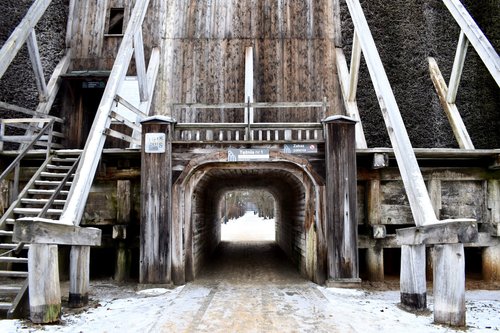
The three graduation towers stand out as the most distinctive elements of the site with their combined total length of 1,741.5 meters and a height of 15.8 meters. Towers I and II are mainly wooden structures, standing on 7000 oak piles stuck in the ground, with a timber frame made out of pine wood and blackthorn twigs fillings. They were constructed between 1824 to 1828. Graduation tower III was added 1859 and has a stone and brick foundation. While the towers are working throughout the year, the entrance to the top is only open seasonally from spring to autumn and requires an entrance fee. Graduation Tower I includes a tunnel passage that lets you pass through to the other side and a small windmill on the top of one end. The wind mill was key to pump the brine up the towers and let it trickle down and evaporate. Steam engines were also used originally, but have since been replaced by electric motors. It would be interesting to know, if people were already practicing salty air inhalation for health benefits back when the steam engines were still operating.
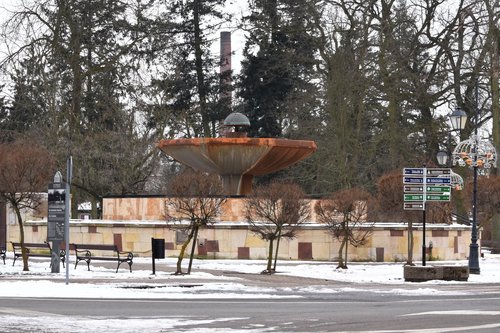
Another component of the complex that is visible within the town of Ciechocinek is the saltwater fountain that roughly resembles a mushroom in shape and colour and hence carries the Polish nick name “grzybek”. It’s part of a system to concentrate the spring brine from the intake chamber below. The modernist concrete fountain basin was designed in 1926, but when the material cracked, it had to be reconstructed in 2015, giving it a rather contemporary look. Respiratory benefits are supposedly also to be experienced when sitting close to the fountain. It is located on top of the intake chamber of the salt brine. When we visited, the water was turned off, so we did not get to experience it in operation.
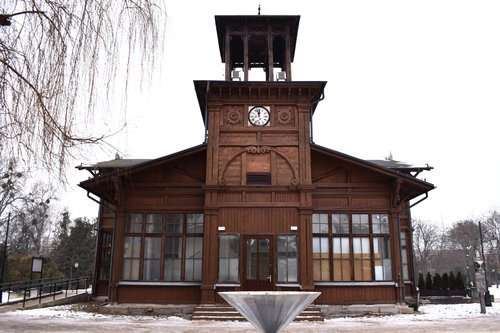
Because of the freezing temperatures on the day of our visit, we also did not make it to the salt factory building (“the saltworks”), as it is a little further afield from the bus and train station. Instead we treated our frozen heads to a cup (or four) of hot chocolate at the former “Kursaal” or Mineral Water Pump Room. The wooden hall was built around 1880, as an indoor promenade in “Swiss” style, with wooden open lace and a clock tower at one end. It is located in the Spa park and nowadays houses the cafe, with the original interior wood works and taps for mineral water extraction still on display.
While Ciechocinek has built a whole little spa town infrastructure around the respiratory benefits of salt-air inhalation, the main purpose of the graduation towers and the graduation works was to produce salt, or more specifically, to clarify the salt retrieved from underground brine deposits, by removing minerals and residue to improve its quality. The nomination dossier therefore strongly emphasizes Ciechocinek’s industrial heritage of salt production and names an impressively eclectic array of objects that have been used to process the salt brine throughout the decades. The long list includes the wooden graduation towers, an “underground brick-lined brine intake chamber with an electric pump”, a waste water sedimentation ditch, remains of railway tracks and even an “underground PVC pipeline for transporting pre-concentrated and degassed brine”. Not all items on the list are actually visible, when visiting the site. And I’d be surprised to see a PVC pipeline being credited with outstanding universal value, which brings me to my evaluation of the site.
I would agree that the saltworks in Ciechocinek represent regional industrial and recreational heritage, but I am struggling to see how this constitutes global significance, especially in comparison to other salt production or spa town WHS. Even with a more consciously curated list of nominated objects in the dossier, I would find it hard to make a strong argument for the inclusion of the saltworks into the world heritage list. Maybe the nominating party is hoping for a trickle-down effect of the world heritage status down to local touristic development, but my guess would be that this hope will evaporate like salt brine on a sunny day.