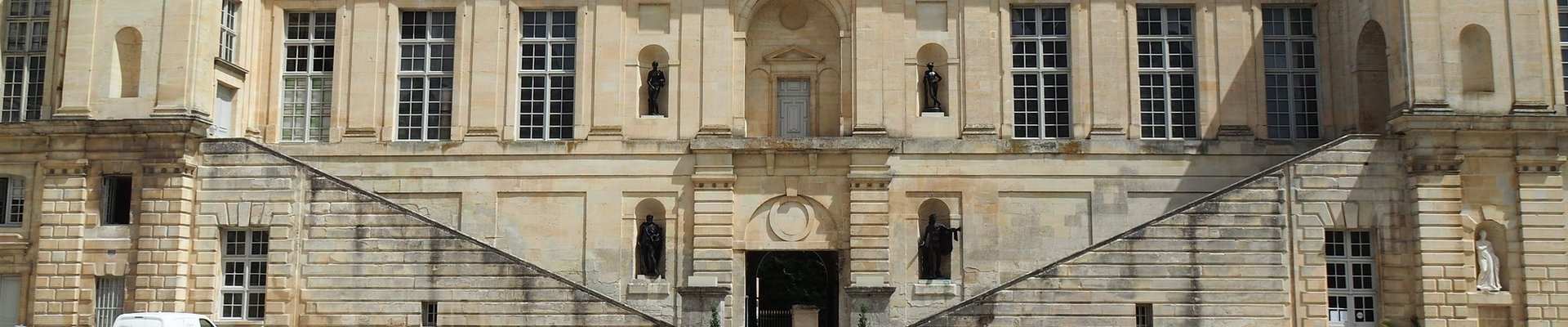
From a practical standpoint, camping under the pine trees near Milly-la-Forêt allows you to tick off the WHS for the Palace and Park of Fontainebleau and the Domaine de Fontainebleau (castle, gardens, park and forest), which is on the tentative list and could be a future extension of the WHS. It's also worth noting that the village is located within the Fontainebleau and Gâtinais Biosphere Reserve.
The castle is easily accessible from the campsite via the D837, which we did on a rainy day. We decided to visit the exterior of the castle and the park because, unlike the other WHS members, we aren't particularly fond of castle interiors...
The construction of the buildings as we see them today spanned from 1528 PC to the 19th century.
It is generally accepted that the Château de Fontainebleau is representative of the French Renaissance of the 16th century, but personally, and this is only a personal opinion, I find that the way the buildings have been added over time and the façades of the château do not rival those of the Italian Quattrocento and Cinquecento buildings, such as those that can be admired in Florence, for example, or in Rome and the Veneto, even though Italian artists were invited to the court to form what is known as the first and second Schools of Fontainebleau. The Pazzi chapel designed by Filippo Brunelleschi (1441-1446 PC) or the Villa Rotonda by Andrea Palladio (1566-1571 PC) are much more harmonious and homogeneous than the heterogeneous assemblage of facades designed at Fontainebleau by architects of different eras. This is very evident in the Oval Courtyard (The photo) where, in my opinion, there is no link between the different facades, neither in the rhythm of the bays nor in the balance of solids and voids.
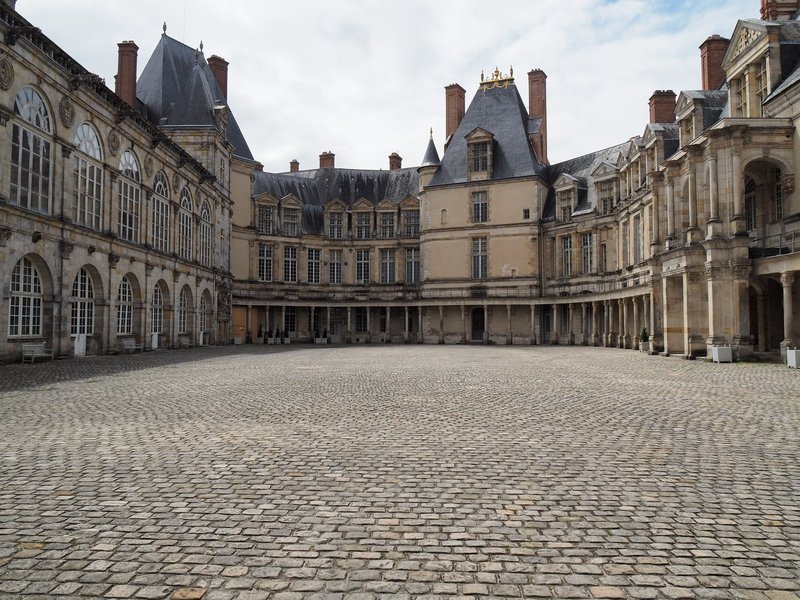
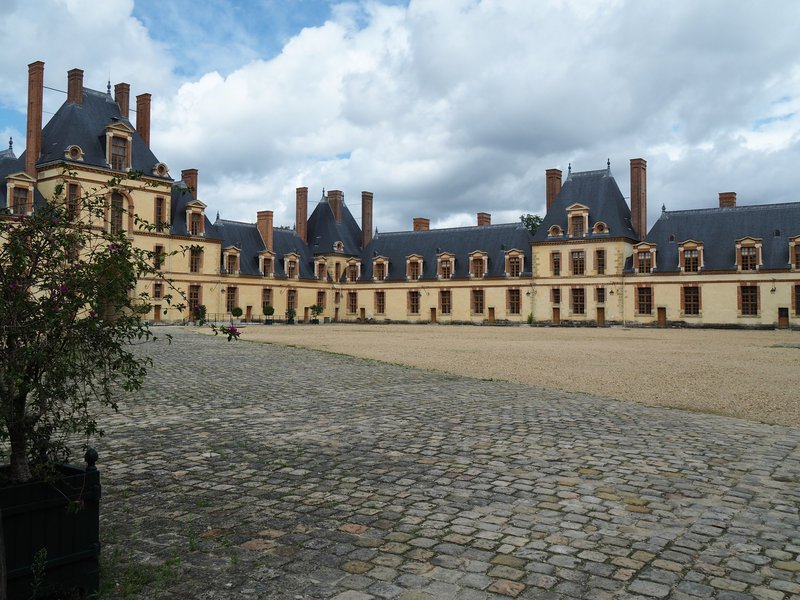
We couldn't find the castle parking lot, so we parked along the park and entered the courtyard of the white horse alone, like Tintin and Captain Haddock in front of the facade of Moulinsart Castle. We were surprised to see that the entrance to the castle overlooks the town of Fontainebleau, whereas it was originally a royal hunting lodge, therefore logically, in the middle of the forest? The entire park is surrounded by urban areas except on the side of the "Le Romulus" fountain, which is a bit of a shame. In the White Horse Courtyard, the side wings and the horseshoe staircase are quite stylish, but we abandoned them to go to the Fountain Courtyard where, as James Bowyer says, it is possible to quench your thirst on the terrace of a pleasant brasserie and drink a royal coffee. Unfortunately, the Golden Gate was hidden by scaffolding and tarpaulins. Access to the park and gardens is via a carriage entrance under the wing of the Belle Cheminée, and from there to the Oval Courtyard and the Courtyard of the Offices, but as Hubert says, the Oval Courtyard was closed. It can still be seen, however, through the bars of the metal gate. (Again, the same photo as before)
The gardens designed by Le Nôtre could offer a good preview of his finest work at Versailles and Vaux-le-Vicomte, both easily accessible from Fontainebleau, which I would recommend. The Carp Pond lives up to its name; there's a small basin to the side where enormous carp spawn, and the island pavilion in the pond is quite charming. One can easily imagine members of the court arriving there by boat, illuminated by torches.
You really need to dedicate two full days to the region if you want to tick the box on the WHS and the one on the tentative list, because the Fontainebleau forest is teeming with paths and wildlife. We saw a dead doe along the road, hit by a car... It's also a renowned spot for climbers who enjoy bouldering on what they call "climbing blocks". These blocks are large, very typical sandstone boulders, not very high but difficult to climb. They put a mat on the ground so they can try climbing and fall as many times as they want. I promised myself I would go back for a walk in the forest when it rains less... that way I can tick the second box of the estate and imagine the members of the court on horseback hunting deer!
On the edge of the forest lies the village of Barbizon, birthplace of the Barbizon school of landscape painting, a precursor to Impressionist art. A museum pays tribute to it.
Comments
No comments yet.