Myanmar
Pyu Ancient Cities

The Pyu Ancient Cities comprise the archaeological remains of a group of city-states, founded as part of the southward migration by the Tibeto-Burman-speaking Pyu people.
Their cities of Halin, Beikthano and Sri Ksetra are stretched out alongside the River Ayeyarwady. The settlements were fortified and central palace citadels were constructed. The Pyu culture was heavily influenced by trade with India, importing Buddhism as well as other cultural, architectural and political concepts. Each of the cities had imposing brick memorial stupas and extensive monastic quarters.
Community Perspective: Clyde describes Sri Ksetra (with one stupa "having the shape of a woman's breast"), while Alexander (he found “the site staff in 'UNESCO preparation mode”) and Els (“low heaps of brick in farmland will get few people excited”) visited Halin.
Site Info
Official Information
- Full Name
- Pyu Ancient Cities (ID: 1444)
- Country
- Myanmar
- Status
-
Inscribed 2014
Site history
History of Pyu Ancient Cities
- 2014: Advisory Body overruled
- ICOMOS recommended Deferral
- 2014: Inscribed
- Inscribed
- Type
- Cultural
- Criteria
- ii
- iii
- iv
Links
- UNESCO
- whc.unesco.org
- Related
-
- worldheritagesite.org — Getting to Hanlin
- mmtimes.com — Stepping back in time in Hanlin
All Links
UNESCO.org
- whc.unesco.org — whc.unesco.org/
Related Resources
- worldheritagesite.org — Getting to Hanlin
- mmtimes.com — Stepping back in time in Hanlin
News Article
- Jan. 19, 2019 irrawaddy.com — Police Investigate Suspected Burglary of Ancient Pagoda in Sri Ksetra
- Sept. 2, 2015 mmtimes.com — Since being listed as a World Heritage Site, the ancient city of Sri Ksetra has seen a surge of visitors
Community Information
- Community Category
- Archaeological site: South (East) Asian
Travel Information

Red Zone Travel Advisory
Recent Connections
-
No Map
The nomination dossier has reasonable q…
-
Red Zone Travel Advisory
Myanmar fully off-limits -
Archaeological potential
"The three cities are partly excavated …
Connections of Pyu Ancient Cities
- Architecture
-
-
Wooden architecture
Beikthano, ... combining brick and wooden architecture (AB ev) -
Brick architecture
Beikthano, ... combining brick and wooden architecture (AB ev)
-
- World Heritage Process
-
-
No Map
The nomination dossier has reasonable quality maps
-
Slow Starters
1994-2014 : 20 years -
First inscriptions
Myanmar (2014)
-
- Religion and Belief
-
-
Introduction of Buddhism
criteria iii "The Pyu Ancient Cities marked the emergence of the first historically-documented Buddhist urban civilization in Southeast Asia." criteria ii "Due to interaction between indigenous Pyu societies with Indic cultures from the 2nd century BCE, Buddhism achieved its first permanent foothold in Southeast Asia among the Pyu cities, where it was embraced by all classes of society from the ruling elite to agrarian labourers." (OUV) -
Stupa
still standing monumental brick Buddhist stupas (AB ev)
-
- Human Activity
-
-
Irrigation and drainage
complex system of irrigation and water storage using elevated weirs canals, dykes, sluice gates, moats and water tanks (AB ev)
-
- Constructions
-
-
Moats
"The Pyu cities’ urban morphology set a new template of extended urban format characterized by massive gated walls surrounded by moats" (OUV)
-
- Timeline
-
-
Built in the 2nd century BC
from around the 2nd century BCE to the 3rd century CE (AB ev)
-
- Science and Technology
-
-
Archaeological potential
"The three cities are partly excavated archaeological sites"
-
- Visiting conditions
-
-
Red Zone Travel Advisory
Myanmar fully off-limits
-
News
- irrawaddy.com 01/19/2019
- Police Investigate Suspected Burgl…
- mmtimes.com 09/02/2015
- Since being listed as a World Heri…
Recent Visitors
Visitors of Pyu Ancient Cities
- AC
- Alejandro Lau
- Alexander Parsons
- Alex Baranda
- Astraftis
- Atila Ege
- Bernard Joseph Esposo Guerrero
- Celina Nanbara
- Cheryl
- chiuliqi
- Clyde
- Dimitar Krastev
- Els Slots
- Errol Neo
- Francky D'Hoop
- Frederik Dawson
- Javier Coro
- Jonoprout
- Luboang
- Lucio
- Luke LOU
- Michael Turtle
- Morodhi
- Nihal Ege
- PabloNorte
- Roman Bruehwiler
- Sergio Arjona
- Shannon O'Donnell
- Thomas Buechler
- Zoë Sheng
Community Reviews
Show full reviews
This is the second phase of my eight-day journey to Pyay, ancient Sri Ksetra, and Beikthano, undertaken after an invitation from an archaeologist I met during an ICOMOS field trip in Viet Nam. After three days exploring the vast plains and shimmering waters of Sri Ksetra, our group set out for Beikthano. The road stretched for nearly four hours across rural Myanmar, dotted with military checkpoints. While checkpoints are common from Yangon to Pyay, those beyond Pyay seemed more active and watchful, a stark reminder of the country’s fragile political climate. The landscape shifted as we drove. Sri Ksetra had been vibrant, crisscrossed by canals, reservoirs, and green fields, but the approach to Beikthano revealed endless dry rice plains, bleached under the sun. As we entered the archaeological zone, our Myanmar SIM cards lost signal entirely, a precaution for military security, our guide explained.
Our exploration began at the Beikthano Ancient Museum. Its displays echoed what I had seen in Sri Ksetra and at Yangon’s National Museum: terracotta objects, stone urns, beads, and fragments of architecture. With fewer excavations here, the collection felt modest, yet it provided an essential glimpse into the earliest stages of Pyu civilization. From the museum, we visited Beikthano Village, known for its pottery. The villagers produce exquisite earthenware, often adorned with motifs reminiscent of ancient Pyu designs. It was a rare joy to witness a living craft that so closely echoes a culture more than two thousand years old. The …
Keep reading 0 comments
I began my eight-day journey to Pyay or Sri Ksetra and Baikthano after receiving an invitation from an archaeologist I had met during an ICOMOS field trip in Viet Nam. He was organizing a rare study tour to the Pyu ancient cities during a brief moment of calm in Myanmar, just before the coming election. The team planned to push deeper into the country, traveling from Pyay to Beikthano to conduct fieldwork that had been impossible during the most intense years of conflict then continue to observe heritage damage in Mandalay area. Weighing both travel time and safety, I chose to join only the Pyay & Baikthano portion, a decision that still promised a deep dive into one of Southeast Asia’s oldest urban civilizations.
Before heading north, we spent a reflective afternoon in the National Museum in Yangon. In the early Myanmar gallery, glass cases displayed stone urns, bronze fittings, silver vessels, and ancient coins excavated from Sri Ksetra. The objects revealed the roots of Pyu culture and the flow of Indian influence into the region, Mahayana architectural motifs from eastern India, Amaravati, blending with Theravada traditions linked to southern India and perhaps Sri Lanka. This synthesis helped shape the spiritual and artistic DNA of the Pyu, a society that flourished centuries before Bagan rose to power.
Arriving in Pyay later next day, we headed straight for Phaya Gyi, one of the three monumental stupas of Sri Ksetra. Set amid open fields and surprisingly close to the national …
Keep reading 0 comments
Myanmar’s very first WHS came as a surprise in 2014: few will have visited one of the Pyu Ancient Cities before its inscription. History-wise, it is not an illogical choice, however. The Pyu were the first of the civilizations that settled along the Ayeyarwady River, in what is the heartland of current Myanmar. They started building city-states here from the 2nd century BC. They came from the north (the Tibeto-Burman plateau or India) and brought Buddhism with them.
None of the three Pyu cities Halin, Beikthano and Sri Ksetra lie close to the main tourist destinations in Myanmar. While I was staying in Mandalay, I hired a car plus driver and guide for the day and went for Halin. Though only 95 km, the trip took us 2.5 hours. We found our way out of the busy streets of Mandalay, and then passed the lovely Sagaing with its numerous gilded stupas. Afterward it’s a long haul northwards in the direction of Shwebo. The guide had been there once before, but they do not make it out to Halin often. So driver and guide took some time asking around for the right turn-off. It turned out that there is a huge sign pointing to the World Heritage.
From that sign, it’s another 17 km on a semi-paved country road. We had to stop several times to let cattle and goats pass. Halin was and still is a major agricultural area, the land made fertile by irrigation. You’ll mostly see …
Keep reading 0 comments
I have been to Halin, 2oo9. Archeology-that many writers wrotes. This is a right spot that UNESCO had chosen. But there are many things to learn /study here- ceramic tiles and Kilns, (now obsolete), Sardaw Oak's (the King's overseer of salt production) his house where no nails were used and built over a hundred years ago, salt export to Western Yunnan, Snake cult, Manipuri invasion, mud pots and mud volcanoes,hot springs, Japanese occupation period, Four layers of inhumatioon, Jormon pots (earliest pottery)etc. etc. There will be no end to learn.
Keep reading 0 comments
I visited this WHS in December 2012. I passed by Halin and Beikthano and decided not to visit due to time constraints and since I had seen quite a number of temples and brick ruins during my 3-4 week visit in Myanmar. Luckily however, I decided to stop and visit Sri Ksetra or Tharay-khit-taya. The main highlights of my trip were the stupas that could be seen at the 4 corners of this large ancient city, one of which was proudly described as "having the shape of a woman's breast". Now that Myanmar has its first WHS I sincerely hope that other sites will follow. Myanmar is a beautiful country and one of its main assets are the wonderful and kind people that live there.
Keep reading 0 comments
While in Mandalay in December 2013, I felt compelled to visit the remote archaeological site of Halin, as it seems likely to be Myanmar's first inscribed site during the convention in 2014. Had this not been the case, it would be inconceivable to spend a day travelling out to this location, through extremely rutted 'roads' that are normally limited to motorbikes and ox-carts.
The local archaeology department certainly believes that it will be inscribed, and probably the most fascinating aspect of the visit was seeing the site staff in 'UNESCO preparation mode'. A museum was being literally built in front of us, with the small existing part filled with artifacts in plastic bags. Staff were categorising them with photos, and assembling a large table-map of the area. They seemed a bit flustered to have foreigners barging in, but happily charged us for a $5 entrance ticket. An English language brochure was supplied, with 'UNESCO nominated world heritage list' as the initial heading. This was obviously new, as was the English language signage on the building.
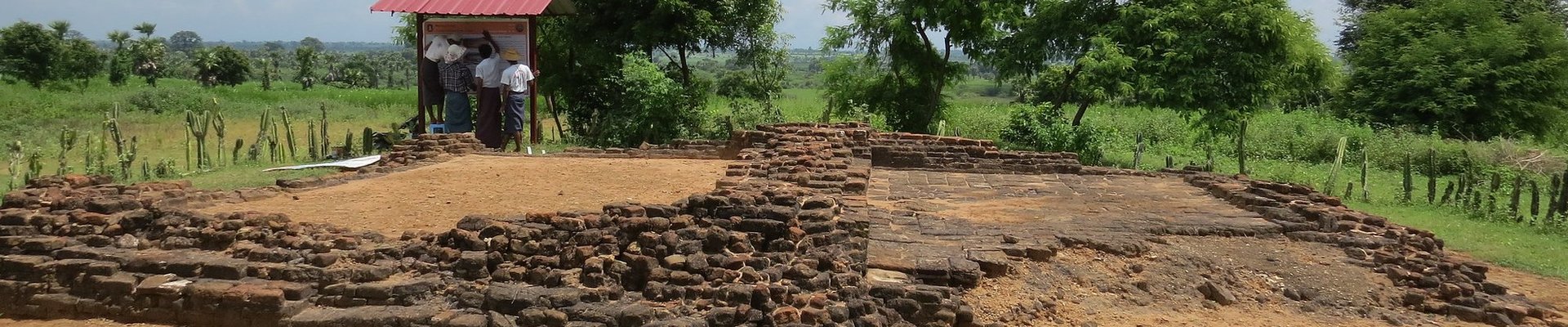
The actual site is spread across a large area of peanut farms, with a few dozen specific areas of excavation. These are not impressive ruins like more famous ancient cities or temples, but instead foundations of walls and monuments, slightly rebuilt to about knee height. This is not to say they are not interesting, but do not expect to be awed at first glance.
More shocking were the sites of human burials, but not for …
Keep reading 0 comments