
Budj Bim Cultural Landscape was the final UNESCO World Heritage site I visited in 2025 (visited Dec 2025). We based ourselves in Mount Gambier, about a 1.5-hour drive away from the site. The property comprises three components: Budj Bim (northern), Kurtonitj (central), and Tyrendarra (southern). While it is technically possible to visit certain publicly accessible areas in each component in a single day, I chose to slow things down and focus on one area instead—Lake Surprise within the Budj Bim component.
Budj Bim and visitor access
Budj Bim is the largest component, accounting for around 90% of the total area, and is arguably where most visitors go. Meaning “high head” in the Gunditjmara language, Budj Bim refers to the volcanic complex (Mount Eccles was its colonial name), with Lake Surprise forming its crater lake. Tae Rak (Lake Condah) and Lake Surprise are the main visitor-accessible areas within Budj Bim. The Tae Rak Aquaculture Centre in Tae Rak offers cultural tours to Budj Bim and Kurtonitj but is closed on Mondays and Tuesdays—the very days we were staying in Mount Gambier. Winda-Mara Aboriginal Corporation also offers tours to Tyrendarra, but after contacting their office they confirmed that they were understandably on a holiday break from 22 Dec until 5 Jan.
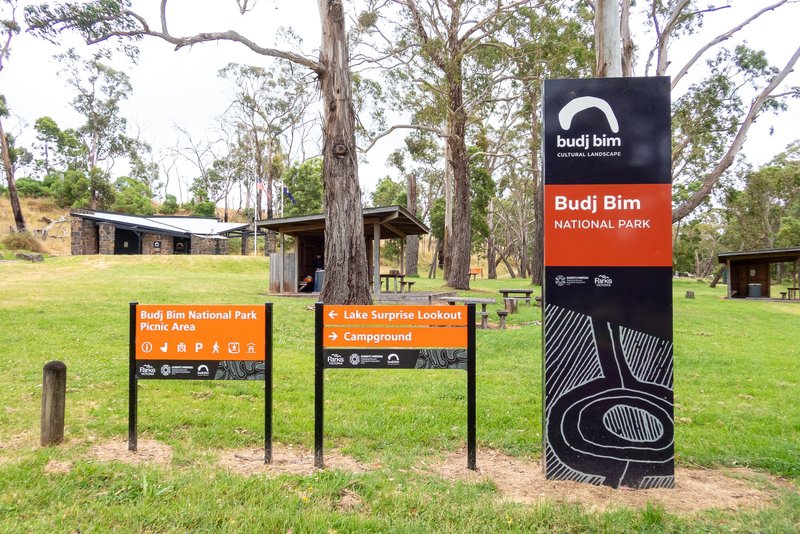
Activities around Lake Surprise
Walking, picnicking, camping, and cycling are essentially the main activities available to visitors in the area. We arrived at the campground shortly after lunch and set up for a picnic. After finishing our snacks and a bottle of Barossa rosé, I set off to explore the area around the lake. From here, visitors can access four walking tracks: Lake Surprise, Crater Rim, Natural Bridge, and Lava Canal. The Lake Surprise track, which offers a close-up, level view of the lake, was closed at the time of our visit due to natural hazards and unsafe trail conditions, with no indication of when it might reopen.
I began exploring the lava tube adjacent to the campground. From there I started the Crater Rim walk, following the trail clockwise from the lava tube. Warning signs about snakes are hard to miss, though with the wind picking up and dark clouds rolling in, I was more concerned about falling branches than wildlife. In fact, I was hoping to see some snakes, birds, and koalas, but all I saw were grazing cattle in the farmland bordering the trail.
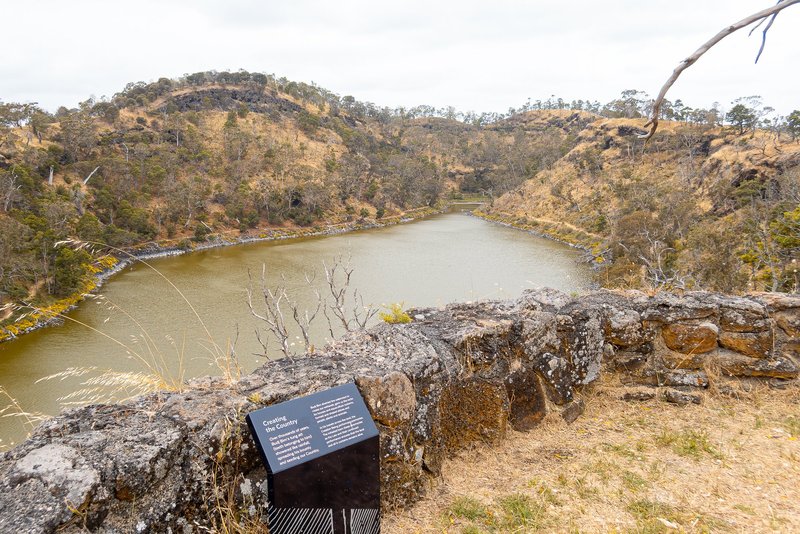
Hikers would perhaps walk past the interpretation panels along the Crater Rim Walk, but unless you have done a good deal of pre-reading, the panels are helpful to understand the intangible and subtle OUV of the site. They are less about individual features and more about helping visitors how to read the landscape—explaining the volcanic origins of Budj Bim, the formation of Lake Surprise, and its cultural connection to Gunditjmara people.
It took me about an hour to complete the trail, and that included frequent stops to take photos (Crater Rim Walk was advertised as a 2-hour walk). I had planned to tackle another track—possibly the Natural Bridge—but decided instead to head back to the car. We decided to call it a day and drive on to Port Fairy, around 40 minutes from the park.
How about the other components?
Given my choice of area to visit, I did not encounter the channels, weirs, and dams that feature so prominently in the nomination dossier as the most tangible expressions of the site’s OUV. While I was fine with it, I'd encourage visitors to take tours or even check out all three components. However, if like me you want to focus on a single area or have limited time, you may consider what each component represents. Based on my experience, this is what the Budj Bim component offers:
- Visiting Tae Rak would allow you to see intentional engineering and systematic food production through its channels, weirs, and artificial ponds.
- Visiting Lake Surprise would allow you to appreciate Gunditjmara's Dreamstory of the origins of Budj Bim.
Happy for fellow enthusiasts to comment on what they think Kurtonitj and Tyrrendara represent in view of the site's OUV.
Comments
No comments yet.