I am particularly keen to write a review of the Victorian Trades Hall—part of the serial nomination of the Workers’ Assembly Halls—for a few reasons. First, previous reviews have not covered this property in detail and I am happy to be doing such for the first time. Second, my visit was a good example of how asking sometimes pays off. And lastly, I think it has a strong chance of becoming a UNESCO World Heritage site (hear me out on this one). I visited the site in Dec 2025, and this is how it went.
When asking paid off
Victorian Trades Hall Council offers only a few tours a year and are perhaps the only way to explore the building in detail. As I was visiting over Christmas, it wasn’t surprising that none were scheduled. I reached out to their office to ask (with a bit of enthusiasm) whether any tours might be planned and mentioned that I’d really appreciate the chance to join one. A couple of weeks before my trip, they sent me a message confirming they were going to run a tour, though on my last day in Melbourne. On the day of our tour, our guide mentioned that my request had helped make it happen—a nice (and quite flattering) bonus.
The tour
Our tour began in a meeting room. There were only four other guests who all seemed to be affiliated with unions or labour groups. With such a small group all huddled in a room, and the Trades Hall staff seemingly already on break, the tour felt personal and relaxed.
Our guide started off by giving us a bit of history of the labour movement in Australia, including the events that were associated with Victorian Trades Hall and the significance of these events in Australia and other countries. This part of the tour gradually became a sit-down discussion of how mass organisation of workers in Australia from mid-19th to early 20th century had evolved and impacted many aspects of our life beyond work (more to this in the next subsection). Some of the key events in Australia's labour history that can be tangibly observed in the site are:
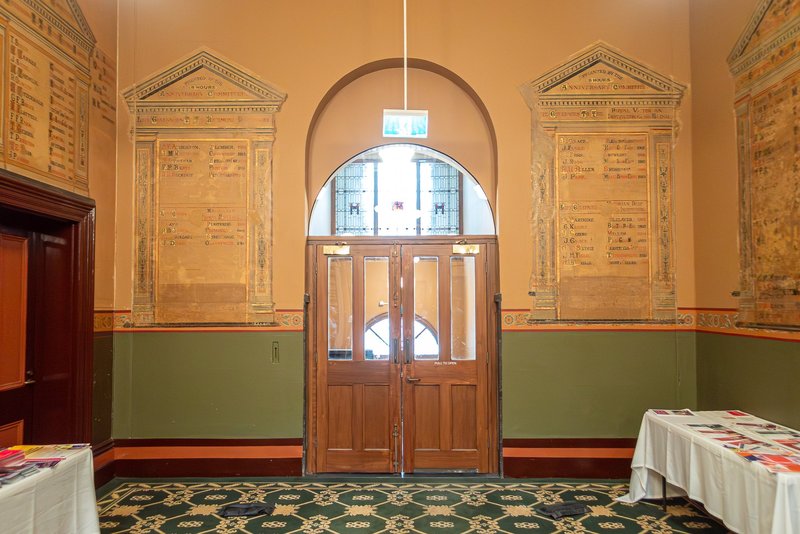
- The construction of the building itself - the Trades Hall is believed to be the oldest workers’ hall in the world still in use today. Some of the major labour organisations in Australia were established here. There are honour boards and plaques in the foyer and walls that recognise early union leaders and their campaigns.
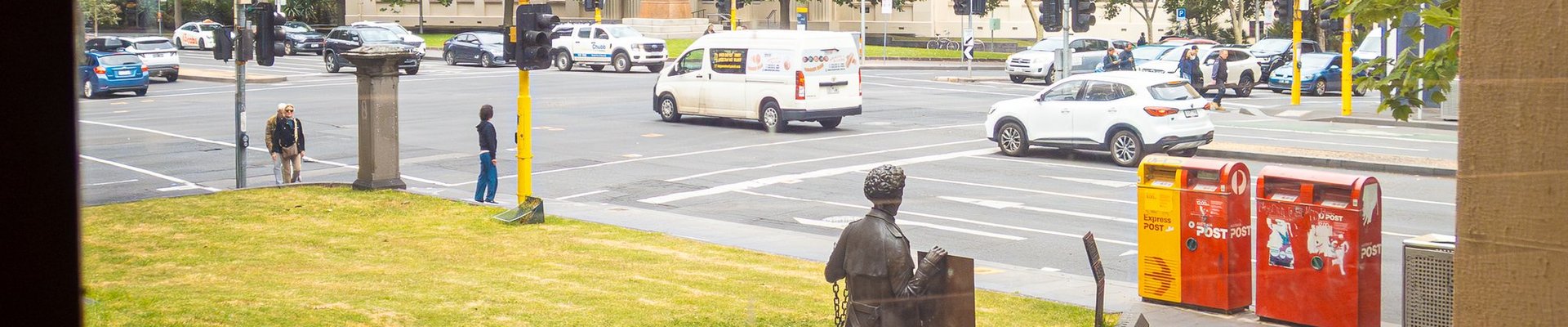
- The 8-hour day movement - well, aren't our adult lives shaped by the 8-hour work day? Melbourne is credited as the birthplace of the modern eight-hour workday movement, all due to Melbourne's stonemasons demand for 8 hours of work, 8 hours recreation, and 8 hours of rest (or 888). The eight-hour day monument at the intersection of Victoria and Russell Streets outside of the building commemorate this.
- Zelda D’Aprano's protest - a labour and feminist activist who chained herself to the doors of the Commonwealth Arbitration Court protesting for equal pay. She was famous for the quote: "Today it was me, tomorrow there will be two of us, the next day there will be three and it will go on and on and there won't be any stopping it." A bronze statue was erected just outside the hall. Victorian Trades Hall Council offers a Feminist Tour.
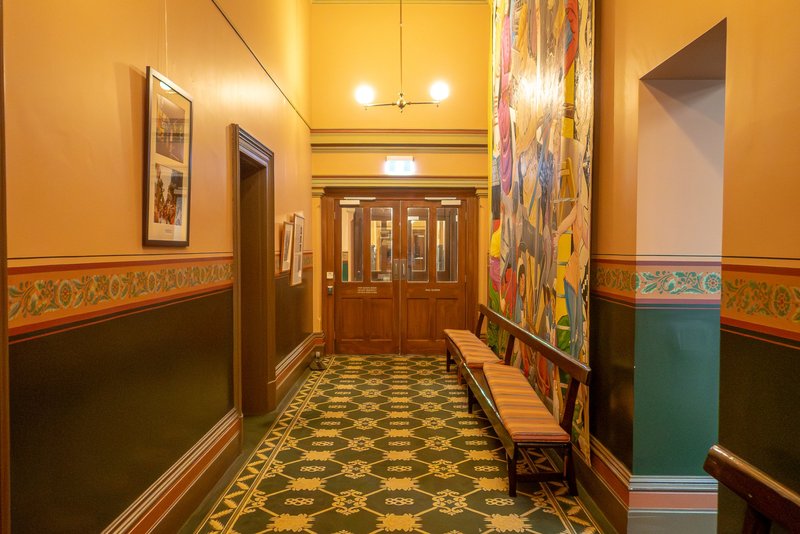
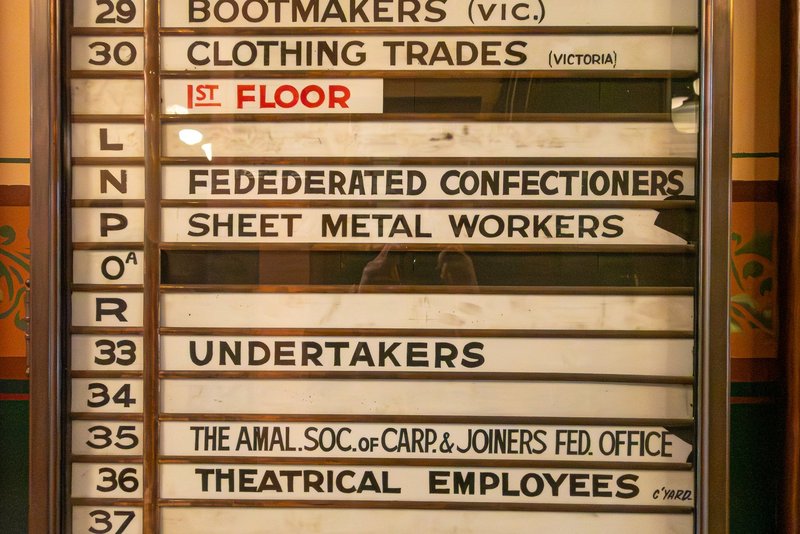
Our guide then took us on a tour of the ground floor and the building's facade on Lygon Street. She showed us the staff offices, historic rooms, social spaces, halls, walls, and artwork and photographs. Note that the floor of some corridors and rooms are covered in carpets with the 888 symbol. At the entrance foyer you can also see the historic directory boards that listed trade unions and affiliated organisations, each assigned with a room or office number and floor (see photo at the bottom). I chuckled when I saw that there was a room for undertakers. We also visited another hall whose walls are lined with honour boards and commemorative plaques bearing inscriptions linked to Australia’s labour history.
We finished the tour of the ground floor and the group proceeded to the upper floor. At this point I had to excuse myself to catch a flight, though before I left, our guide gave us a bit of an overview of what's on the upper floors. This included the Old Council Chamber, which looks like a parliamentary chamber with some painted friezes and paintings; and the Solidarity Hall, a bigger hall with lots of murals and is used for big events and assembly meetings.
Do Workers' Assembly Halls have a place in the World Heritage convention?
Personally yes
The Victorian Trades Hall represents seemingly modest and local historical events but whose influence and reach have impact on contemporary human condition—our current work-life. The events associated with this Trades Hall still resonate to us until now, and are very much relevant to how work-life could evolve in the future. For example, our tour group saw the connection between the 8-hour day movement and Australia's push for a four-day work week, which is creating a bit of a buzz in some countries such as the UK, and here in New Zealand.
The significance goes beyond labour rights
The events associated with the site also testify to how the labour movement influenced broader societal issues. Like, talking about Zelda was talking about advancing equal pay, and campaigns for fair wages, safer workplaces, and reasonable working hours often overlapped with women's recognition in the workforce. There were also events that sought fair treatment and acknowledge of indigenous rights (including the culture and land rights), and of migrant workers. This reflected the labour movement's contribution against racism and exclusion.
Its OUV under criterion 6 is strong
I think the site's OUV is particularly strong under criterion (vi). The idea of workers being free to organise and advocate for better working conditions is a universal concept, and we even celebrate this idea through Labour Day. And as mentioned, the buildings had borne witness to social movements against racial and gender discrimination.
While the State Parties have also suggested criteria (iii) and (iv), I feel like they are a bit of a stretch and inscribing the site under a single criterion is totally fine. While folks from the World Heritage Committee generally prefer criterion 6 to be used alongside other criteria, over the years we've seen many sites being inscribed solely under this criterion. I also note of Els' review on De Vooruit and her comment about the authenticity of tangible remains.
Mining x Workers' Assembly Halls
Having visited another tentative site that is focused on mining heritage (e.g., Australian Cornish Mining Sites: Burra and Moonta), cannot help but think that these sites would complement each other remarkably well. Some of the pivotal events in labour movement are associated with mining workers (see Australia's economic history). And so, I feel like if the Australian Cornish Mining Sites and Workers' Assembly Halls are inscribed within the same year, it would be kinda poetic and satisfying, and would highlight the connection between industrial heritage and labour rights.
Comments
No comments yet.