
After reading Zoe's review on Songkhla’s proposed World Heritage nomination, I understood the frustration regarding the lack of accessible information on the location and on the values of the nominated sites. Fortunately, thanks to an expert friend from ICOMOS I met during the field trips in Cambodia and Vietnam, I received valuable guidance about the key places to visit and their cultural significance. This allowed me to better appreciate the uniqueness of Songkhla and its surrounding heritage landscape. The nomination appears to focus on the long history of multiple settlements around the Songkhla Lagoon, reflecting centuries of maritime trade, cultural exchange, and coexistence of different communities. The lagoon itself is central to this story: as the largest natural lake in Thailand, connected to the Gulf of Thailand by a narrow opening, it offered a safe anchorage for ships, a thriving fishing ground, and fertile land for settlement. Its sheltered waters facilitated early maritime networks and created a natural hub for exchange between inland communities and seafaring traders from across the Indian Ocean and South China Sea.
The old town of Songkhla struck me as a charming and vibrant district, often described as a smaller version of George Town in Penang or Hoi An in Vietnam. It retains the lively atmosphere of a historic Chinese settlement, with rows of shophouses revealing layers of history through their architecture from elegant Sino-Portuguese façades to touches of Art Nouveau. The mix of commercial and residential functions still feels authentic, and the community life adds to the living heritage character of the town. A must-see here is the Hub Ho Hin (Red Rice Mill), an impressive piece of industrial heritage that recalls the town’s prosperity from rice trading and export. Beyond the old town, I explored Boyang District, a predominantly Muslim community that also served historically as a local administrative center. Here stands the Songkhla National Museum, an elegant building in traditional southern Thai style with Chinese influences, once the governor’s residence. Today it houses important collections and helps visitors understand the multicultural history of the region. Not far away, at Samila Beach, the bronze statue of a mermaid. Much like the famous Little Mermaid of Copenhagen, this statue has become the modern and popular tourism icon of Songkhla.
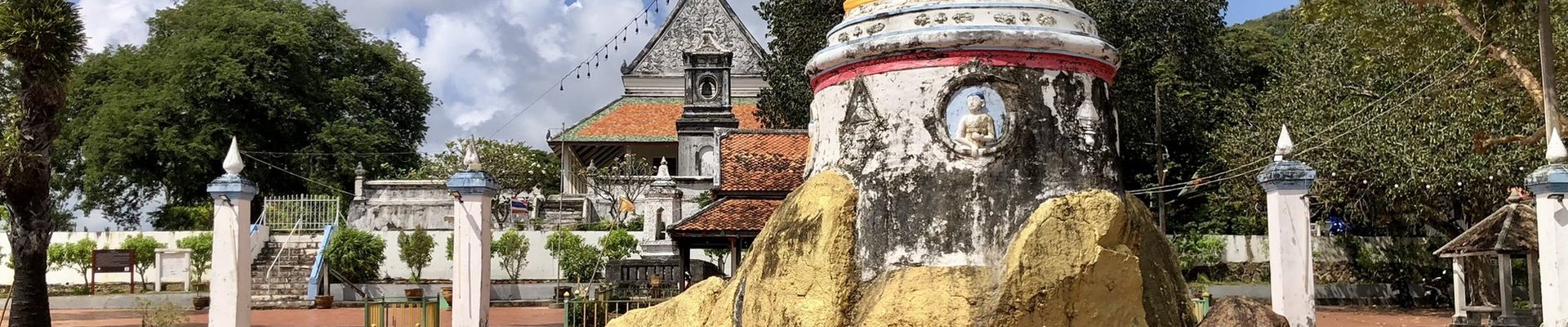
Another highlight of my visit was Fort No. 9, part of the historic fortified settlement of Singora. Located at Khao Daeng and Laem Son on different side of lagoon shore of Songkha, this fort interestingly demonstrates the integration of European military design into a Southeast Asian context. The bastions and walls show a clear influence of European styles, yet they also reflect local adaptation, making the fort an important testimony to global encounters in the early modern period. Further inland, I explored the remnants of ancient towns that once shaped the cultural landscape of the region. At Wat Si Yang, the sole surviving evidence of the former Si Yang Ancient Town, stands an ancient stupa constructed from coral stone. The unusual material and form recall early Buddhist monuments in Indonesia, suggesting seaborne cultural connections across the wider Indian Ocean world.
Nearby, the remains of Pha Kho Ancient Town survive through two remarkable religious sites. Wat Pha Kho features a hilltop pagoda that resembles the Great Chedi Stupa of Wat Mahathat in Nakhon Si Thammarat, underscoring the strong regional religious and artistic exchanges. Yet Wat Pha Kho is not only significant for its architecture: it continues to serve as a pilgrimage site for locals, who venerate its former abbot from centuries ago, remembered as a holy saint. This living spiritual devotion enriches the historic value of the site and demonstrates how past and present coexist in Songkhla’s cultural landscape. Equally significant is Boran Sathan Khao Kuha, a 1,200-year-old man-made cave temple where a Shiva lingam was discovered. This evidence of Hindu worship reveals the diversity of religious practices in early southern Thailand and reflects the area’s role as a crossroads of Indian and local traditions.
Seen together, these sites highlight how Songkhla Lagoon served as the heart of a complex cultural landscape: ancient towns, fortified settlements, religious monuments, industrial heritage, museums, and modern symbols all flourished along its shores and nearby. The lagoon was not just a geographical feature but the foundation for Songkhla’s identity as a maritime hub, where Chinese, Malay, Indian, and local Thai influences converged over centuries. This journey allowed me to see Songkhla not only as a provincial town but also as a place of cultural significance that deserves wider recognition. If George Town and Melaka, which are already recognized as World Heritage Sites, represent maritime history on colonial interpretation, then Songkhla and its lagoon tell a different, earlier story, one grounded in the networks of Chinese, Malay, and Muslim merchants. This alternative narrative of ancient maritime exchange and multicultural coexistence, anchored by the natural importance of the lagoon itself, is what makes Songkhla’s heritage distinctive, and why it deserves further study and global acknowledgment.
Comments
No comments yet.