Foreign visitors to Laos are very likely to arrive or depart by plane from Vientiane Airport, the capital.
It would be a shame not to spend some time in the city to soak up the atmosphere and visit, among other things, Wat That Luang, which the Laotian nation hopes to have inscribed on the World Heritage List. Day and night, the general atmosphere in Vientiane is relaxed, much like in Luang Prabang, though a little less secluded.
My friends, my wife and I had landed in Luang Prabang Luang Prabang in winter 2025 where we rented a car to visit the north of the country, including the Plain of Jars.Plain of jars in winter 2025, and end in the capital where we caught our flights back to our respective homes. I think it's better to do the loop in this direction rather than the other way around, otherwise you risk being disappointed by the capital.
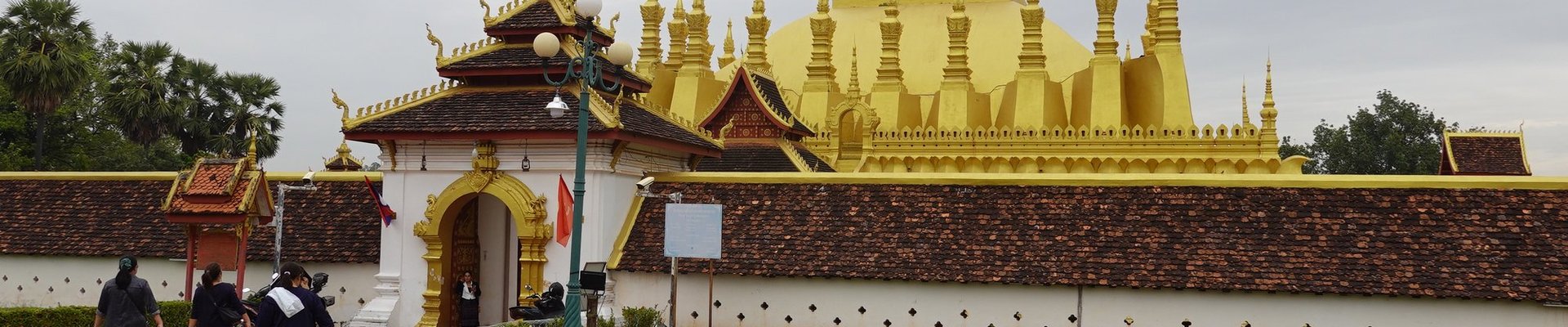
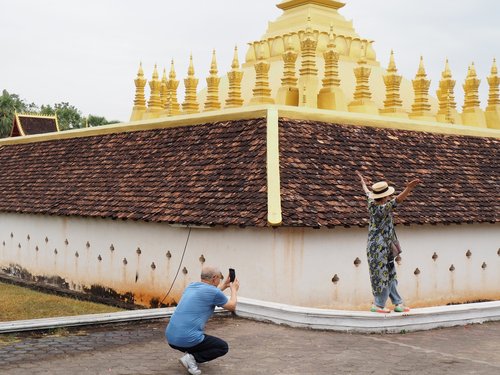
As we were staying in the presidential district along the Mekong, we had to take a tuk-tuk to visit Wat That Luang, which was 4 km away. As I already wrote in the column about Luang Prabang, I am quite easily impressed and it was my first time in Southeast Asia, so it was difficult for me to compare the Wat That Luang site with other Buddhist sites, but the building seemed impressive enough on the one hand, and unique in its form which has no equivalent in Europe on the other, that I would find it a shame not to make the effort to put it on the UNESCO list (The introductory photo).
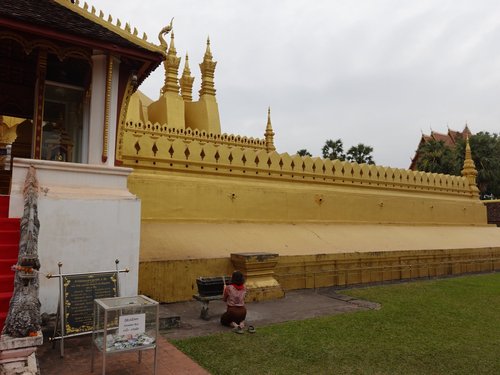
This golden building, 68m on each side and 45m high, is, according to tourist guides, the heart of Laotian Buddhism. It's both a patriotic site, said to house a hair of the Buddha himself, and a museum. I saw a woman prostrating herself before what's called a haw wai, one of the four covered staircases leading to the second level. On this floor, another gallery runs along the four sides of the wat, concealed by 120 stylized lotus petals, and provides access to the third and fourth levels, which are unfortunately closed. Climbing up there symbolizes the passage from ignorance to enlightenment. It's therefore also a local cultural site (see photo).
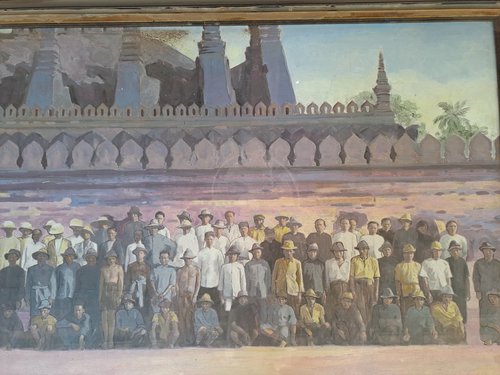
The museum is housed in an open gallery that runs all the way around the Wat, like a cloister. Beautifully crafted sculptures and other objects are on display and are worth the visit alone (approximately €2.50 per person). One oil painting particularly moved me: it depicts the workers who participated in the restoration of the building with French assistance during the colonial period, from 1931 to 1935. The dual aspect of the building's antiquity and its recent restoration within the specific context of colonization seems to me to deserve emphasis (see photo).
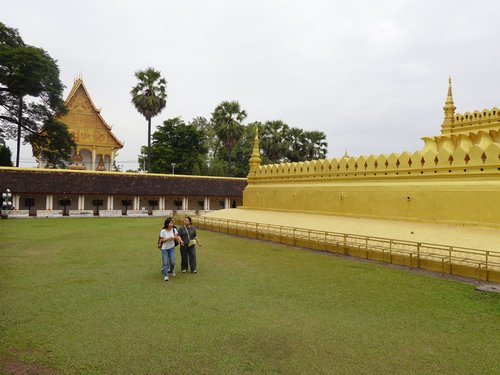
If the monument were ever to be classified as a UNESCO World Heritage Site, it should be with a buffer zone large enough not to distort its aesthetic value and its approach via a wide, open esplanade. This should be fairly easy: the monument is surrounded by other valuable monuments, such as the Wat That Luang Tai monastery to the south where there is a huge reclining golden Buddha and the Wat That Luang Neua to the north.
Note that there is a smaller scale recent copy (approximately half the size) in Luang Namtha. The site is secluded and very pretty with a beautiful view of the city at sunset.
And while you're there, don't hesitate to spend several days in the city to also visit:
# Wat Sisaket (approximately €2.50 per person) is a monastery founded by a king in the early 19th century. It is also surrounded by a cloister whose outer walls are adorned with thousands of small niches with flying buttresses. There is a small Buddha statue in each niche; it's magnificent!
# Just opposite is the Vat Phra Keo monastery, which was also directly under the king's authority. It's also a museum (approximately €2.50 per person).
These two buildings deserve to be listed in the same way as Wat That Luang, that would seem consistent to me.
# The national museum has finally reopened on the outskirts of the city in a new building. The museum is interesting from both a historical and ethnographic point of view.
The certificates of award of the intangible cultural heritage of humanity for the Fonelamvonglao dance, the traditional craft of weaving the naga motif and the kène music, signed by the President of UNESCO, are proudly displayed in gilded frames in the entrance hall! To have !
A few woven pieces featuring naga motifs were on display, along with bamboo flutes used to play kene music. Unfortunately, none of the screens were working, so I couldn't see what the Fonelamvonglao dance looked like.
In conclusion, go see the stupa, is it stupefying or stupid? Stupefying (the photo).
After that stupid pun, I would say: I give a thumbs up, not to hitchhike at the end of the airport runway, but to show the way to those who come after!
Comments
No comments yet.