Growing up, I always assumed Buddhism was East Asian; Chinese, to be precise. It wasn't until I saw Little Buddha (released in '93) by Bernardo Bertolucci that my misunderstanding was corrected: Buddhism originated in India?! As a Lutheran adolescent growing up in Northern Germany, I may be forgiven for these gaps in my religious knowledge. However, if you were to ask a Chinese person if Buddhism is Chinese, they may very well say "yes," much like an American views English as their own language: Chinese Buddhism is a distinct evolution, deeply intertwined with the "Three Teachings" alongside Confucianism and Taoism.
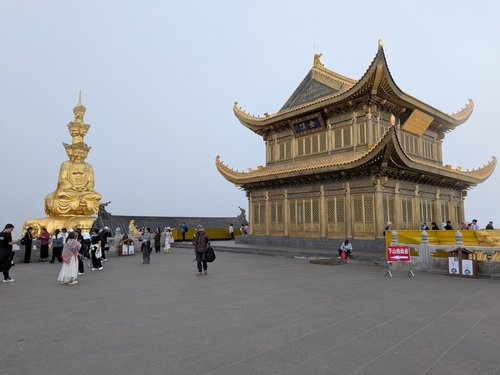
In China, Mount Emei is one of the Four Sacred Buddhist Mountains (not to be confused with the other Sacred Mountains). It is historically significant as the bodhimanda (seat of enlightenment) of Samantabhadra, the Bodhisattva of Practice. It is also home to the site of the first Buddhist temple built in China, dating back to the 1st century (63 CE). Today, the mountain— soaring to over 3,000 meters — is covered in pilgrimage trails and over 30 monasteries. At the summit, known as the Golden Summit, stands the breathtaking 48-meter tall, multi-faced golden statue of Samantabhadra atop four golden elephants. If you are lucky and the clouds allow, you may witness the "Buddha’s Halo," a rare optical phenomenon. It seems Frederik was privy to the privilege. On our ascent we got the more typical "summit covered in clouds" experience.
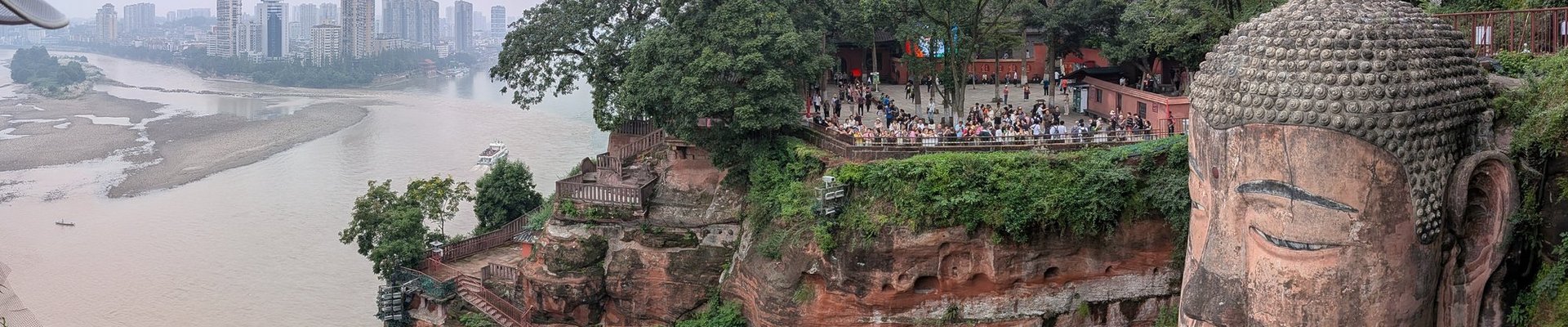
The Leshan Giant Buddha, meanwhile, was built later, during the peak of the Tang Dynasty. Carved directly into the Lingyun Mountain cliffside over a period of 80 years — starting in 723 CE and finally completed in 803 CE — it was the brainchild of a monk named Hai Tong. Positioned at the confluence of the Min, Dadu, and Qingyi rivers, this 71-meter Maitreya (Future Buddha) was intended to exert spiritual "law" over the turbulent waters that claimed so many lives. Interestingly, the project was a feat of ancient engineering; the stone debris dropped into the riverbed supposedly calmed the currents. Of the two, Leshan is the lesser site. The Buddha is undeniably massive, but it has been heavily restored over the centuries. The eyes you see today weren't there in the early 20th century. You can see the heavy-handed changes in historical photos.
Our itinerary took us from Dujiangyan to Leshan for two nights. We spent a full day on Emei: starting at the Baoguo Monastery at the base and the Emei museum. Then we walked to the tourist centre and caught a park bus to reach the cable car for the final ascent. The following day we spent half a day exploring the Giant Buddha at Leshan.
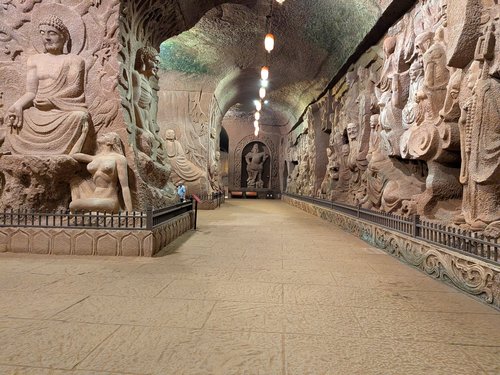
Both sites have received the full Chinese AAAAA tourist treatment—meaning visitor centres, shuttle busses, cable cars, and boat tours. In Leshan, they have added a sprawling "cultural theme park" featuring hundreds of Buddha replicas in artificial caves. Whether the ticket staff is genuinely proud of this or just upselling, we couldn't tell. In any case, they directed us to start our visit at the theme park, so we had to hike a significant distance just to get back to the actual core zone. A wisdom we learnt over and over in China: Follow the crowd. If the local tourists are all getting off the bus, get off.
Ultimately, Emeishan and Leshan were a finishing highlight of our visit to Sichuan. Sichuan is a diverse region rich in great world heritage sites. Mount Emei is it's cultural crown jewel.
Getting There
Both Leshan and Mount Emei are well-connected by China’s High-Speed Rail (HSR) network, but the stations aren't exactly next to the sites. In Leshan, a Didi will get you from the station to the scenic area. At Mount Emei, the process is a bit more complicated: you must first get from the train station to the tourist transport center and from there you can catch a mountain shuttle.
To travel between the two cities, you can either hop back on the train, take a bus or simply hire a cab. If you are staying on the Leshan riverfront to enjoy the nighttime views of the illuminated cliffs, it often makes more sense to take a taxi straight to Emeishan rather than backtracking to the station.
Both sites enjoy frequent connections to Chengdu (ca. 1-2h). Connections to Dujiangyan or Xi'an are less frequent (daily?). We arrived via a direct train from Dujiangyan to Leshan. I had hoped to take a direct train back to Xi'an, but tickets were sold out, so we ended up transferring in Chengdu Dong (East) Station.
For those short on time, Leshan is a very feasible day trip from Chengdu. If you are willing to catch a very early train, you could also squeeze in a visit to Emei as a standalone day trip. But trying to combine both Leshan and the Golden Summit in a single day is not possible
Getting Around
In Leshan, park shuttles are available to ferry you from the gate to the core zone. While they save a bit of energy, the distance isn't massive; you could easily take a nice walk along the river. For a different perspective, boat tours offer the best way to see the Giant Buddha in its entirety from the water. These all depart from the visitor centre.
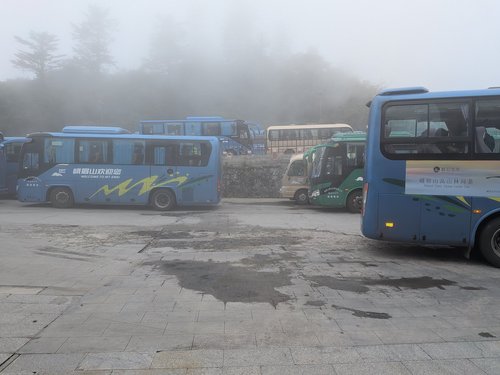
Mount Emei, meanwhile, logistics are more challenging. You can hike to the summit, which takes several days and incredible stamina, but most visitors opt for the shuttle buses and cable cars. These buses wind up the mountain to the cable car stations — a journey that takes 1 to 2 hours each way. Be mindful when boarding, as buses serve different stations and monasteries. For those nervous about the mountain roads, the buses are tightly speed-monitored for safety, and they even factor in a brief toilet break during the long ascent.
Where to Stay
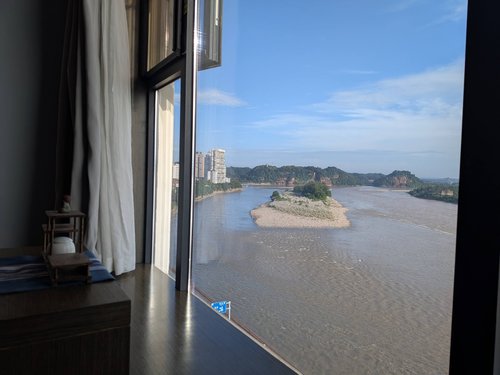
We opted to stay in Leshan at a hotel overlooking the river confluence, with the Giant Buddha visible in the distance. It was very scenic, and staying in a larger city meant plenty of food options and amenities. However, if your goal is to catch the sunrise at the Golden Summit or simply maximize your time on the trails, staying in Emeishan city — or even at one of the monasteries on the mountain itself — is the smarter play for an early start.
Comments
No comments yet.